
Volcanic Systems
Field Documention 01
Site: Vulcano & Stromboli, Aeolian Islands & Mount Etna, Sicily
Status: In Residence, Winter 2026
Subject: The Logic of Living Landscapes
1.The Physical
2.The Sensory
3. Structural Intelligence
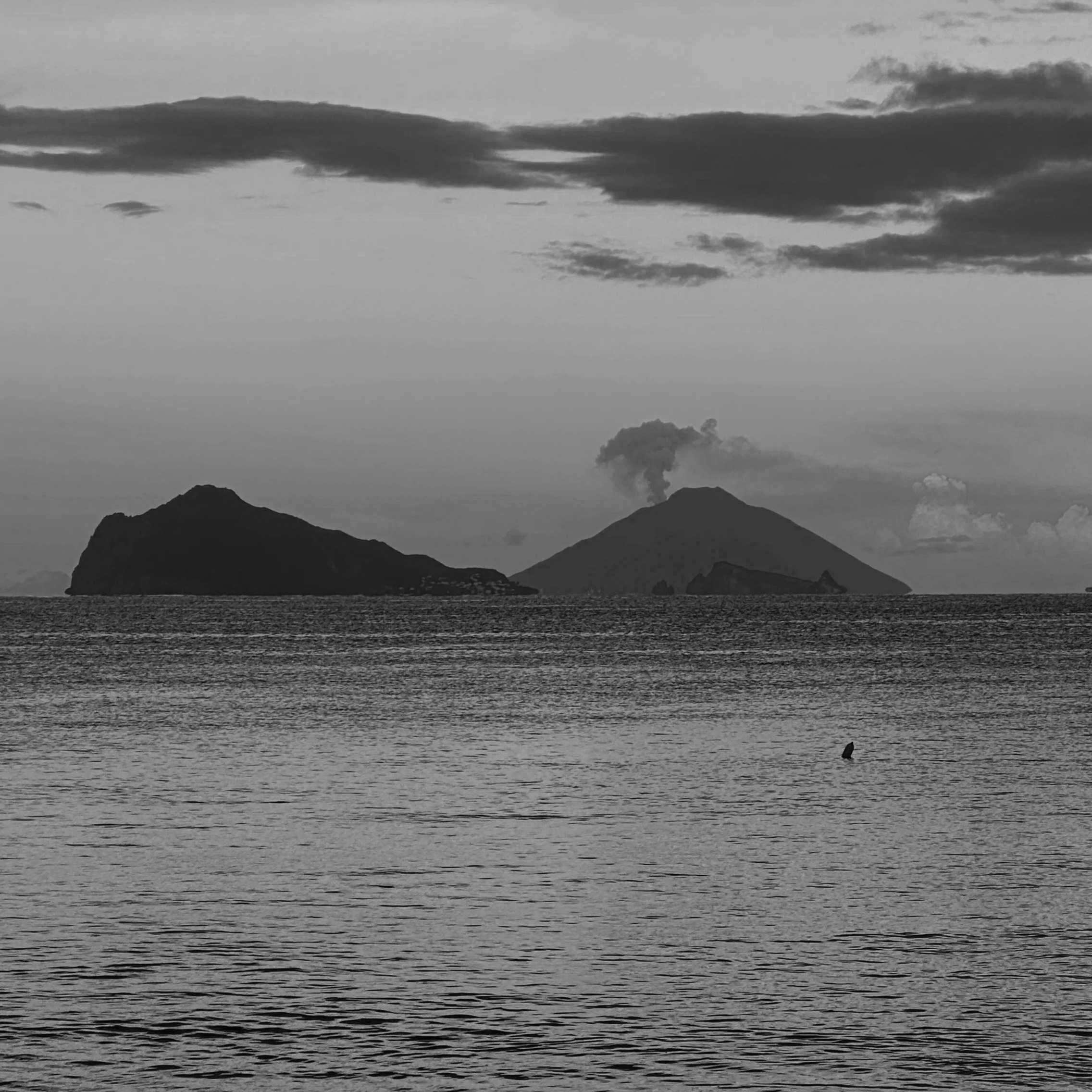
The Physical
Geological Condition
Heightened volcanic activity across the zone.
Presence of ash, pumice, basalt and obsidian. Active fumaroles on Vulcano; Stromboli releasing intermittent smoke plumes. Etna erupting Christmas 2025.Terrain
Underfoot: ash, pumice fragments, compacted dark sand. Crater edges on Vulcano are rounded by wind erosion. Shorelines shift between coarse black stone and fine volcanic dust. Steep, conical silhouette of Stromboli visible across open sea.Atmosphere
Warm mineral air around Vulcano; sulphur layers with maritime breeze. Light haze over the water during active phases. Air clarity shifts quickly with wind; sudden openings of sharp visibility.Sound
Low-frequency rumbles from Vulcano’s thermal vents. Ambient quiet punctuated by short seismic signatures.Phenomena
Smoke plumes rising from Stromboli, direction changing with wind. Thermal vents on Vulcano releasing steady vapor. Dark slopes absorbing light, creating strong tonal contrast.Colour Field
Volcanic black and deep grey dominate. Oxidized red appears in exposed rock. Sulphur yellow near vents.
Pumice creates lighter natural highlights; obsidian gives sharp reflective blacks.Human Trace
Sparse interventions: paths worn into ash, safety rails near fumaroles, minor structures around access points.
Overall scale emphasizes human smallness; built elements feel temporary against the landscape.Immediate Response
A territory that feels alive and in motion. A dialogue between heaviness (basalt, obsidian, depth of colour) and volatility (steam, haze, shifting smoke). Tension. Everything holds potential energy.
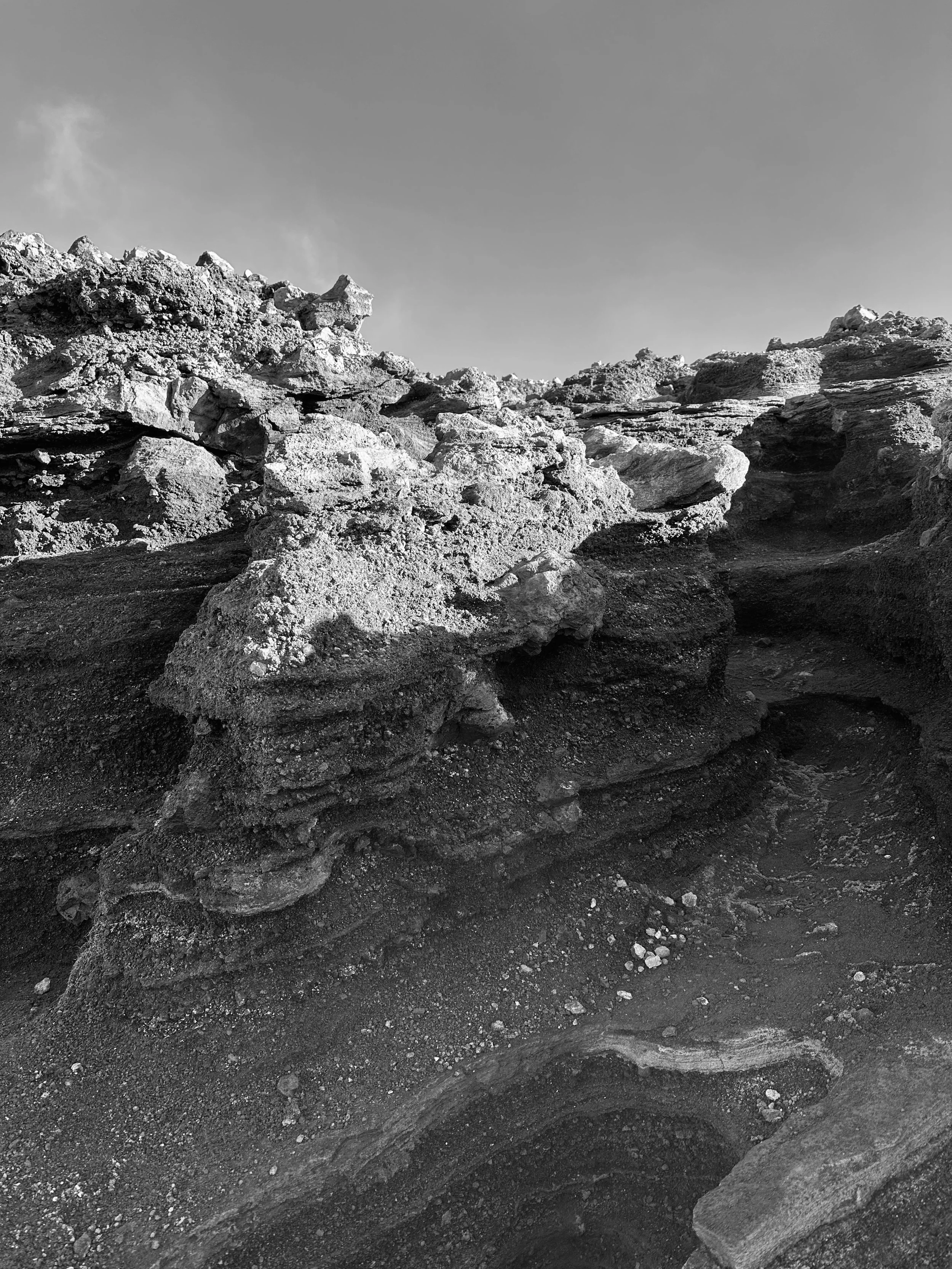
The Sensory
Temperature
Noticeable contrast between warm mineral pockets near Vulcano’s vents and cooler maritime air. Skin notices quick shifts; warmth feels localized rather than ambient.Air Density
The air feels heavier near sulfur zones, slightly thicker in the throat. Breeze over the water thins the density; the change is immediate and sharp.Sound Texture
On the Aeolians background noise is minimal; silence carries weight.Light Behaviour
Strong directional light on dark volcanic surfaces increases visual contrast. Black stone absorbs light, creating visual depth and occasional glare on obsidian. During haze, light diffuses and softens edges.Spatial Sensation
Open sea creates a wide perceptual field. Vulcano feels close-range and tactile; Stromboli feels distant but commanding.
Perception oscillates between intimacy and scale.Movement
Steam and smoke create slow vertical motion. Wind pushes horizontal movement across the surface of the sea. Eye is drawn between the two axes constantly.Scent
Sulfur sits sharp at the top of the nose on Vulcano. Marine air clears it quickly, giving intermittent relief. The contrast sharpens awareness rather than dulling it.Surface Feedback
Walking on pumice produces a muted crunch; ash absorbs sound. Ground feels uneven, granular, slightly unstable at times.Immediate Sensory Impact
A heightened state of alertness. The blend of heat, density and low-frequency sound pulls attention into the environment, system stays engaged, scanning, adjusting, absorbing.
Structural Intelligence
This study examines how beauty forms under extreme forces. It is a cross-field analysis of how actively shifting geological environments shape Perception, Coherence, and Orientation.
We use the volcanic system as a masterclass in Essential Conditions as a perfect example of 360-degree intent.
More in the upcoming QUARTERLY, released March 01, 2026.
