Beneath the Surface: Tina Norden on Design and Perception

Sitting across from Tina Norden, you understand immediately why she has become one of the steady forces at Conran and Partners. Precise, moving from anecdote to insight and always circling back to the thinking that shapes the work.

A partner at the practice, she leads design teams in London and Hong Kong, and since joining in 1997 has built a portfolio that stretches across continents: hotels, restaurants, and residential projects throughout Europe, Asia, and beyond. That breadth gives her a particular angle on aesthetic intelligence, on what holds as universal and what bends with context.

When I dive straight into how Conran and Partners translates ideas like memory, time, and emotion into spatial form, she smiles: “That’s the million dollar question, isn`t it?”

Nearly three decades into the practice, her approach is exact. Research into place and history anchors the concept, giving each decision a rationale that can withstand scrutiny. When a choice is challenged, you can explain its logic. A client may still lean another way, but at least the conversation moves rather than stalls.

This is where aesthetic intelligence becomes visible: not in the spark of inspiration but in the clarity of the reasoning underneath each choice.

The Fine Line

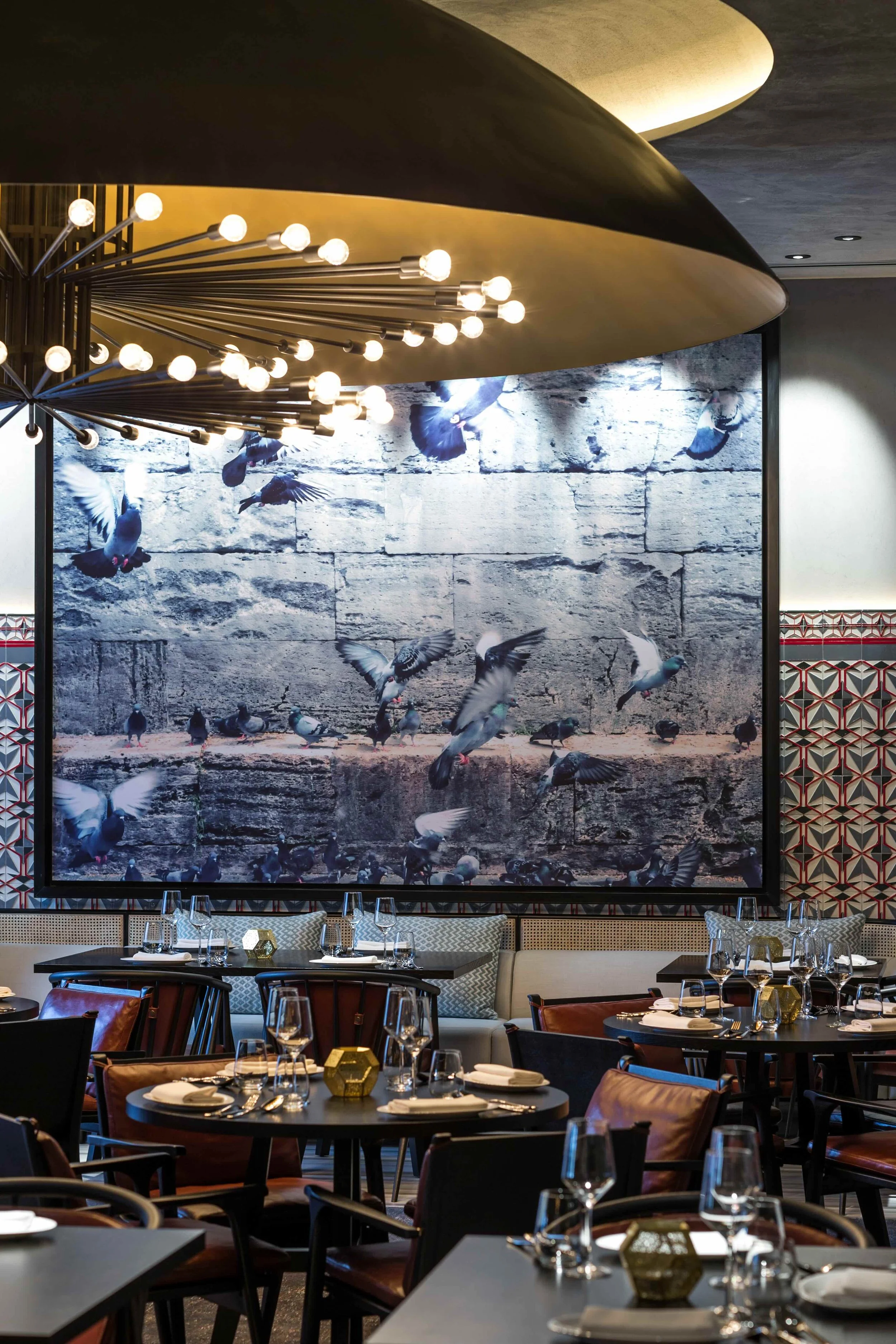
One of the projects she brings up is the German Gymnasium at King’s Cross, a restaurant housed in what was once a Victorian gymnasium. The marble floor carries an inlay that echoes the markings of a sports hall. It’s a quiet nod to the building’s past. Most guests register it as strangely familiar without knowing why. The staff can use it as a narrative, or it can sit there on its own, working in the background. The design operates on several levels at once: a narrative tool for the team, and a subtle cue that lets visitors sense the building’s history without ever needing it spelled out.

I tell her I’m drawn to this kind of layering, the meta level of design. The way a small trace of memory can shift the atmosphere of a space even when it’s not immediately visible.

The last thing you want, she says, is anything themed or overly literal. The reference has to sit underneath, almost like an afterimage.

The intelligence is in the calibration. Knowing how much to reveal, how much to withhold, and how far a reference can stretch before it tips into something obvious. It’s a skill honed by repetition: seeing, again and again, how different degrees of memory and meaning actually play out in lived space.

Universal and Particular

What makes Tina’s approach compelling is the way she roots an intuitive process in systematic thinking. We end up talking about Professor Charles Spence, the Oxford experimental psychologist whose research on multisensory perception has been giving scientific language to what designers have practiced instinctively for years. I had interviewed him earlier; she had shared a panel with him at IHS this year on sensory experience. It’s an interesting overlap because it shows where design intuition and empirical insight meet.

She mentions the Hotel Maximilian in Prague, where Conran and Partners made the guest rooms entirely blue. The rationale had several layers. Prague is saturated with color, and they wanted to echo that energy. Blue is also the most broadly loved color across cultures, and it has a naturally calming effect. For a leisure hotel where people come to decompress, that combination serves both the cultural context and the neurological response. The essential question at the start, she says, is always the same: what emotions are you trying to create.

This is where aesthetic intelligence really operates. It lives at the junction of universal principles - how color, proportion, and light affect the body - and the particular knowledge shaped by experience. Knowing that blue calms is one kind of knowledge. Knowing when this specific blue, at this scale, under this light, produces the exact state you’re after is another order entirely.

The Relevance Principle

When the conversation drifts toward trends in fashion, Tina immediately anchors it in time. Fashion can afford to cycle fast. Interiors cannot. A spatial project takes years to develop and requires real investment. What you design today may not open for another five years. If you chase the obvious trend, it will age before it ever meets its public. Endurance becomes its own form of sustainability: if a space can live for fifteen or twenty years without feeling dated, it’s doing its job.

She points to the Andaz at Liverpool Street, originally the Great Eastern Hotel, which Conran and Partners designed around twenty-five years ago. When the refurbishment came fifteen years later, the bathrooms were left almost untouched. Only the taps were replaced. For her, that’s the measure of timeless design. It still spoke to the building, still belonged to an old London structure with its own rhythm and weight.

Another project makes the principle even clearer. Conran and Partners spent eight years working on a Park Hyatt in Indonesia. Because Indonesia is a major copper-mining country, they decided early on to use copper for the metalwork. It was a material tied to place. Then copper suddenly became fashionable everywhere. They were nervous about it reading as trend-led rather than site-led. But the long project timeline pushed through COVID. By the time the hotel opened, the trend had faded. What remained was the rationale. Copper belonged there because the story of the land supported it.

This is how relevance becomes a form of timelessness. When design grows out of place, history, and lived experience, it resists obsolescence because its logic is intrinsic rather than cyclical.

The Curation Question

The beauty of restraint keeps returning in our conversation. I’ve been noticing it myself in smaller boutique hotels where owners often want everything at once, stacking trend on trend as if abundance guarantees impact. Yet there’s a different kind of power in knowing what to remove rather than what to add.

Tina brings up the line attributed to Coco Chanel: before you leave the house, look in the mirror and take one thing off. In design, that principle is more than a stylistic gesture. It’s a discipline. You question every element. Is it necessary. Does it serve the story, or is the space stronger without it.

I find myself asking similar questions more often now. Does this choice make sense. Does it add a layer, deepen the experience, or is it just another piece of noise.

Experience becomes the decisive teacher here. You can support decisions with science, but the real intelligence lies in recognising when the balance is right, when a space has enough presence without tipping into excess. That judgment can only be honed by doing.

What Experience Builds

When Tina started, architects worked on drawing boards. Every wrong line had to be scraped away with a scalpel. Each stroke required thought. Now, you can generate countless variations digitally before deciding which to pursue. But that brings a new question: with so many options, how do you know which is right?

Tina can look at a plan and immediately sense when something is off. The spacing doesn’t feel right. Why? “It just isn’t right. I know.”

I can relate. I recently spoke with someone about using presets and filters to adjust flat light when I shoot or direct. I use them sparingly, deliberately. Why? Because years of study - six years at university and art school, followed by twentyplus years in practice - have trained my eye to perceive the subtlest shifts in light. Analog taught us this discipline: mistakes were costly, materials were precious, and you had to know what you were doing.

I wonder about younger generations creating design in minutes with automated tools. Have they truly learned taste, developed a sense for proportion?

Tina agrees this is a real issue. When design choices are constantly delivered via algorithmic feeds, you rarely cultivate your own discernment. You’re fed what you like, rather than challenged to discover what actually works, or what generates the friction that sparks insight. Experience is iterative. It comes from doing, again and again.

She studied in a world where every line mattered. Now, her teams produce abundant output. “It’s just different ways of working,” she says.

Yet there’s a countertrend: even young designers returning to analog processes, seeking to use their hands, to learn craft.

What Remains

Perhaps they sense something essential. Constraint shapes judgment. When mistakes carry weight, the eye learns differently. You develop the instinct to know when a proportion is wrong before you can even explain why.

This is aesthetic intelligence: the ability to create meaning that works beneath the surface. To curate ruthlessly. To anchor choices in rationale while trusting a judgment that cannot be fully articulated.

That knowing comes from decades of accumulated consequence—seeing what succeeds in lived space, what fails, what creates tension, and what tiny addition transforms a design from adequate to exact.

words by Jean Linda Balke, photography Conran & Partners